Almost every "best FIRE books" list is a ranking, which is the wrong shape for the problem. Financial independence isn't one challenge — it's a sequence of them. The book that changes your life in year one is nearly useless in year six, and the book with the math you eventually need will bore you to death before you're ready for it.
So here's the shelf organized by stage instead. Find the sentence that describes where you actually are, and read that book next.
Stage 1: You don't believe it's possible yet
Most people encounter FIRE as an internet abstraction — a stranger claiming they retired at 34 — and quietly file it under "must have had help." The books that matter here aren't tactical. Their job is to make the idea feel real.
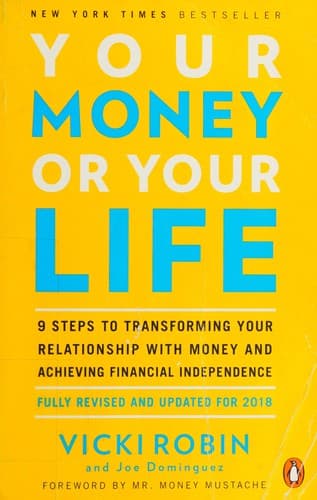
Your Money or Your Life is the origin text, and its central move is a reframe: money is life energy. You trade hours of your finite life for dollars, which means every purchase has a price measured in hours, not currency. Once you've calculated your real hourly wage — after commuting, after the clothes, after the decompression time — the arithmetic of spending changes permanently.
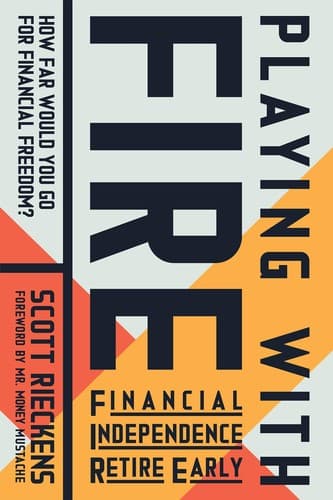
Playing with FIRE does the opposite job, and does it well. Scott Rieckens documents his own family's attempt in real time: the arguments with his wife, the Coronado lifestyle they gave up, the parts that didn't work. It's the least theoretical book on this list, and it's the one to hand someone who thinks FIRE requires a software salary and no children.
Stage 2: You believe it, but the mechanics are fuzzy
You're convinced. You don't know what to actually buy.
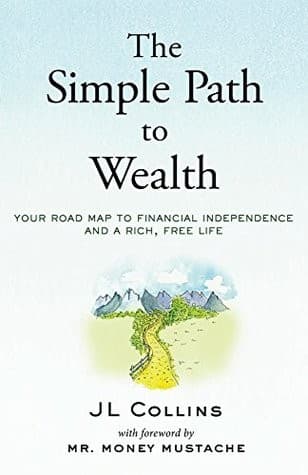
The Simple Path to Wealth is the answer, and it's not close. JL Collins wrote it as a series of letters to his daughter, which forced a clarity most finance writing never achieves. The thesis fits in a sentence: avoid debt, spend less than you earn, invest the difference in low-cost broad-market index funds, and don't touch it.
What makes the book work isn't the strategy — that part is genuinely simple. It's that Collins spends most of his pages on the psychology of not deviating, because that's where people actually fail.
Stage 3: Your savings rate has hit a ceiling
This is the stage where most people stall, and it's the one the FIRE canon historically underserved. You've cut what there is to cut. Your savings rate has plateaued. Optimizing further means arguing with yourself about groceries.
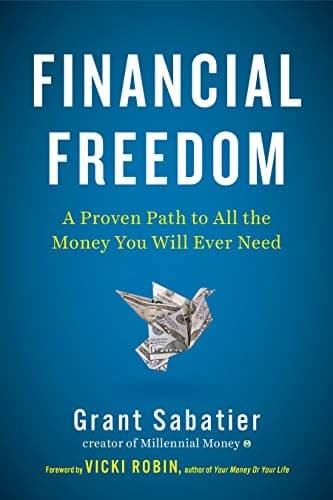
Grant Sabatier's Financial Freedom is the pivot. His argument is that expenses have a floor — you can only cut to zero — while income has no ceiling, so past a certain point the entire optimization should shift to earning. The book covers side income, salary negotiation, and building skills that compound, and it's noticeably more useful than another chapter on frugality.
Stage 4: You want the actual math
Eventually the question stops being "how do I save more" and becomes "how do I know when I can stop, and what happens if the market cooperates badly?"
Quit Like a Millionaire is the most numerate book on the shelf. Kristy Shen and Bryce Leung are engineers, and it shows — they work through withdrawal rates, sequence-of-returns risk, and the specific mechanisms they used to survive a downturn without selling at the bottom. If you want the FIRE math with its assumptions visible rather than hidden, this is it.
Stage 5: You want to accelerate with property
Index funds are the default path, not the only one. If you're drawn to real estate, two books do the practical work.
Set for Life by Scott Trench is about the first phase — house hacking, aggressive savings, and turning a normal salary into a launchpad. The Book on Rental Property Investing by Brandon Turner is the operational manual: deal analysis, financing, screening tenants, and the unglamorous arithmetic of cash flow that decides whether a rental is an asset or a second job.
If you only read one
Read The Simple Path to Wealth. It's the shortest distance between not knowing what to do and doing something correct, and the strategy it describes is the one most people should follow regardless of which stage they're in.
The rest of this list is optimization. Optimization only matters once you've started.